
Gero-Punk Provocation: The Fourth Car

By Guest Essayist

Libby Hinze

libby

“I will be created in the best of your image and you will be created in the best of mine. Joy in the quest.” –Dr. Cornel West

When we arrived the line was long, an energized crowd. Even the bitter cold and wind could not dissuade the eager fans, for we knew that standing in the long line would guarantee us the opportunity to hear one of the great philosophers and political commentators of our time. We had to scurry to the back of the line but once we finally took our spot the night air didn’t seem so cold. Strangers huddled together chattering away. A young man behind me talked to his friend about an up-and-coming trip he was taking across the country. This immediately sparked my interest and I took the opportunity to share some of my favorite stops. A new friendship sparked by our combined love of exploring our planet and meeting others from all walks of life. Our conversation took my mind off the long wait so before I knew it the line was moving forward and suddenly we were inside the auditorium with a crowd of others waiting to see Dr. Cornel West.

The event took place on February 11th, 2016 at the John Greene Hall at Smith College in Northampton, MA. The auditorium seats a little over two thousand people and that evening’s event was certain to be a sell-out. Jenny sat in the final row and I right behind her in a free-standing chair. Wiley (my 18-year-old daughter) ran off to sit with friends. I did what I often do when I first arrive in a room full of people or in this case a room quickly filling up with people, I cased the joint! I watched people as they moved about the room, sometimes noticing a familiar face or two. I told myself stories about some of the characters who presented themselves, I imagined their lives. Then there were those persons who didn’t just show up but, rather, they arrived! There was a presence when they entered the room, the energy shifted a little and I was drawn to them like a magnet to steel.

cornel west

One such character became part of the gravitational pull and found himself sitting right next to Jenny. In the beginning I was too busy observing the crowd to notice. I mean the energy was everywhere so it does not surprise me that he slipped in and sat down before I noticed. As a matter-of-fact, to be completely honest, I didn’t even notice him until I realized that Jenny, who was sitting so near to me, was already far away in deep conversation (which, as you can see, is a common habit between the two of us, we are always picking up new friends along the way).

He sparkled in a room that was already filled with electricity. Initially, I could not hear his words but his hand gestures, facial expressions and over all body movement drew me in from afar. He was with friends who he had left behind to engage with Jenny, though they sat right next to him. He called himself Christopher and he was ecstatic to tell his story (so much so that I wondered if he had ever felt heard before). Beside him sat Jenny, eager to hear every word and in Sassy fashion “take him deeper.”

Christopher is in graduate school and has spent time in South Africa on a study abroad program, working on behalf of human rights for trans-gendered people. He is probably in his late 20s, black and (by his own declaration) gay. When he spoke it was more than words he expressed. There seemed to be an urgency about him, a need to spill out all of what he was feeling and desperately trying to understand. He was raw in the experience of not knowing where he belonged. He didn’t particularly believe in labels or fitting into a box, but by not “fitting in” it seemed that he was a far distance away from opportunities to enrich his life experience by being with others who in one way or another shared his commitment to freedom and equity. He explained his isolation from others like this:

As a gay black man if I was to break down in my car on the side of one of these Western MA country roads I better have a cell phone because nobody is going to stop to help me. Just imagine a car drives by and it is occupied with white folks. The driver doesn’t even think about pulling over to help me. They just keep on going, perhaps wondering, “Why is that black guy out here? He looks like he’s up to no good.” Then the second car drives by, all its riders are black, they may pull over and ask if I need help but the moment they realize I’m gay they’re outta there saying something to the tune of, “That just ain’t right.” The third car drives by and this time there is a white lesbian couple in the car. They think: “Is that big black man safe for us to help?” Now people might not come right out and say it but believe me they are thinking it. And me, I’m still standing on the side of the road with a dead car. I’m still waiting for the fourth car to show up, the car with the person who will stop and help me. Who is driving that fourth car? This is what I need to know.

I have spent the better part of the last 6 weeks thinking about Christopher and his quest to find the driver of that fourth car. I have asked myself to be honest, really honest with myself when I ask, am I that driver?

Despite our differences, we came together to listen to Dr. West speak. During his speech he asked the crowd, “What kind of human being are you going to be?” In my fifty years of life there may not be a better time to ask myself this question, nor to ask others to reflect on it as well.

In other words, or perhaps how Christopher would put it:

What does it take for you to be that fourth driver?

 +++

 Libby Hinze is a Master’s student in Social Work at Smith College in Northampton, M.A. Born and raised in Portland, OR., she has has her B.A. in Human Studies from Marylhurst University and is a certified gerontologist.  Currently she is doing her second year internship at Baystate Medical Center in Springfield, MA. in the Inpatient Palliative Care and Geriatric Department.  She is the single mother of two fabulous young women and the auntie and great-auntie to many more.  Her goal after graduation is to return to Oregon  and host a gathering where her street is lined right down the middle with a long table where there is room for all to gather and enough food for all.


Posted in Uncategorized | 2 Comments

Gero-Punk Press-Release: World Tour 2016

I thought you might like to know that the next leg of my 2016 Gero-Punk World Tour commences next week. Just to remind you: I kicked off the Tour with a play-date at the Treehouse Community in Easthampton, Massachusetts, then bombed on down to So. Cal. for the AGHE conference. Next stop? Missouri!

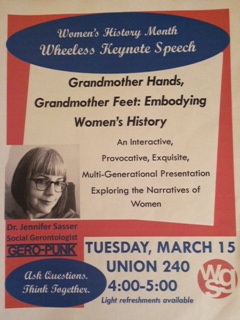
I’ve been invited to participate in the Women’s History Month activities at University of Central Missouri. My colleague and brilliant (Of course! Aren’t they all?) former student Jo Anne Long Walker is the Coordinator of the Social Gerontology Graduate Program and she cooked up the idea of having me come for a visit. I’ll be giving the keynote presentation and visiting a few gerontology courses. So, off I go, hosted by Jo Anne and Wendy Geiger, Chair of Sociology & Gerontology and Cross-Disciplinary Studies. I cannot wait!

My presentation takes place on Tuesday, March 15th, 4-5 p.m. The title is:

Grandmother Hands, Grandmother Feet: Embodying Women’s History

grandmother hands grandmother feet

I’ll be weaving together personal narratives from the Gero-Punk Project with provocative questions and theoretical insights to explore the exquisite particularities of women’s multi-generational, interconnected lived experiences traveling through the life-course. I intend to engage the audience in reflection and discussion about the ongoing dance in which we are all participating: the dance between personal agency and freedom, on the one hand, and the social structures and contexts that shape our lives, on the other, especially as we grow into deep adult womanhood.

As I’ve been designing the choreography for my presentation, especially the framing of the personal narratives I’ll be reading, I keep coming back to the fundamental question: Who is a woman? I’ve also been pondering the very idea that there is such a thing as “women’s history,” deconstructing the idea, asking lots of ultimately unanswerable questions, thinking together with others about it (thanks, friends!),  and rereading stuff I’ve used in my teaching in the past but am now viewing through a somewhat different lens.

Also – and this is wicked fun – I’ve been time-traveling, imaging how a “history” of the times in which we are now living might be read and narrated (certainly, one thing I know for sure is that there will be multiple, even contradictory readings and narrations). I mean, look, the extent to which in our lifetimes the normative gender binary has been disrupted by the complexity of embodied lived experience is stunning, isn’t it? I have people in my life who were born in a body sexed one way but their authentic selfhood demands that they gender themselves otherwise (I use the term “otherwise” intentionally as they have embraced their state as “other” and through this experience they have cultivated great wisdom). They are a them/they now, or a he rather than a she, or a she rather than a he, or they go by a potent new name they’ve given themselves or have been endowed with by another.

There are parallel questions we might (and I do!) ask about the social construction of age and aging. As I’ve pronounced before (and will, I am sure, countless times again), the proper response when hearing a statement about “the elderly” or “older adults” is to ask: Which older adults? Who, exactly, are being referred to?

We humans are so complex, so staggeringly creative that ultimately we can’t be contained within and constrained by convenient categories. One way or another, complexity always triumphs, though the fight is often (always?) messy, painful, even bloody.

History has weight; so does lived experience. Social structures are powerful; so is individual agency.

What will history have to say about they/he/she/we who are living in these times?

Perhaps an even better question is:

How do we want to intentionally embody the history we are creating as we live our precious human lives?

Posted in Uncategorized | Leave a comment

Gero-Punk Praxis: No Longer Invisible

What unique perspectives or experiences might members of a housekeeping staff bring to the care team at a continuing care retirement community or other residential setting for older adults?

cyndi and jenny

Cyndi McKee, left, and I are pointing at the name of Israel Kirk. She was a member of our facilitation team for the original project. At the start of the project, she was Assistant Manager of Housekeeping. Mid-way through the project, she was promoted to the position of Coordinator of Landscape Personnel. She was unable to attend the conference.

That’s the question with which Cynthia McKee and I began our Association for Gerontology in Higher Education workshop presentation this past Saturday, March 5, 2016. In No longer invisible: Co-creating a “Gerontology: The basics” course with housekeeping staff at a university-based retirement community, before we described the intent, design, and outcomes of the course, we invited the audience members to engage in collaborative inquiry, modeling the approach we used for the project.

I’ll fess up here and admit that we used this question as a way to suss our individual and collective assumptions and ideas about the role of housekeeping staff in providing care for older adults living in settings such as continuing care retirement communities. Members of the housekeeping staff are largely unseen and taken for granted, though they are everywhere, doing the behind-the-scenes work that makes things comfortable and tidy for the rest of us. They clean up after us, they interact with what we leave behind, including the stuff that comes out of our bodies. They are close observers, looking into nooks and crannies and between the layers, keenly aware of our patterns and habits, perhaps most especially when they change.

At the particular CCRC where we piloted our project – and this is not uncommon — housekeeping staff are not official members of the care team and, as such, aren’t seen as sources of expertise and insight when it comes to providing care for the older adults residing at the CCRC, despite the fact that they have intimate, regular contact with residents – relationships with residents — and are often the first to recognize that something isn’t right. But while they are the first to know that something isn’t right, they are often the last to hear when one of their residents has to move to a different part of the community to receive more care or, alas, has died.

Given how close-in housekeeping staff members are to the lives of the older adults whom they help care for, it is crucial that they have at least a basic understanding of aging, later life, and old age. I’m sure no one will contest the importance of a well-trained and well-educated workforce in the diverse field of aging. As well, members of the housekeeping staff are in a role that offers many opportunities to serve in a special kind of “gate-keeper” capacity ,  they are an early-warning system alerting family and nursing staff that something may have changed for their older clients and should be looked into. All the more reason to be sure they have the conceptual framework and skills necessary to serve in such an important function. All the more reason to consider them a part of the care team, whether officially or not.

But what assumptions do we make about the unique experiences and perspectives members of the housekeeping staff already have and bring to their work? Do we assume that they are “just” a housekeeper and in need of remedial training? Or do we see them as an essential member of the care team, someone who already has special wisdom to offer, someone who is worthy of receiving and co-creating new educational and professional opportunities?

+++

The day before my presentation with Cynthia, on Friday, just moments after we woke up, Simeon and I heard huge, distorted sounds coming from down on the street in front of the very large Westin Long Beach hotel in which this year’s AGHE conference took place. Given that our room was on the 7th floor of a hermetically sealed modern building, the intensity of the sound was rather jarring. I looked out the window to see what was what. What was what, was:   a picket line of 10 protesters blocking the entrance end of the driveway into the hotel. Two of the protesters were alternating turns on the bullhorn. It took us a bit of time to decipher what they were saying, but the gist of it was: “Don’t check in!”

Of course – this won’t surprise you, will it? – I had to know the details, I had to find out what was being protested and who the protesters were. A bit of internet research lead me to This. In the process of researching the story, I also discovered this website which catalogs all of the hotels in the United States (and in some Canadian provinces) where there are active labor disputes, worker strikes, or threats of strikes. (I am happy to say, there aren’t any hotels in Oregon on the list. And I won’t be making any future hotel reservations without checking this list, now that I know it exists.)

The hotel in which the conference was taking place, the hotel in which I was staying for five days, was on the list (as are several other Long Beach hotels) and there was evidence that the labor dispute had been going on for quite some time with no resolution in sight. Westin Long Beach service workers were protesting unfair labor practices – lack of over-time compensation, lack of legally-mandated breaks – as well as the equally serious matter of their human right to organize and unionize without undue pressure from management.

Making these discoveries left me with a huge moral dilemma. I didn’t have any conference meetings to attend until 11:00 a.m., so we had planned to spend the morning out-and-about, exploring Long Beach. But going out-and-about would require that we cross the picket line and neither Simeon nor I were willing to do so, even if we could sneak out and into the hotel without being seen. We’d both spent most of our lives (starting even before adulthood) involved in various progressive environmental and social justice movements, not to mention our more recent and not uncontroversial work with the American Association of University Professors, attempting to create a union for faculty and staff at the university where we were previously employed.

But it wasn’t only the issue of crossing the picket line down in front of the hotel. We were also uncertain about whether it was right action to even continue to stay at the hotel. Should we check out and stay elsewhere? Should we contact the management and register a complaint? Should I inquire as to whether or not the organizers of the conference knew the conference would be taking place in a hotel with an active labor dispute? My friend and co-presenter Cynthia was en route to the hotel, having taken an early flight that morning; should I warn her that she would have to cross the picket line in order enter the hotel? I didn’t want her to arrive without being aware of the situation, nor did I want to check out of the hotel and leave her there on her own. I was really stuck.

We only knew about the issues at the center of the protest from what we gleaned from the internet and managed to decipher of what erupted from the bullhorn. I thought perhaps we should head down to the street, introduce ourselves to the protesters, and ask them what they were fighting for, what they felt was at stake. I believe the only way to really know what’s happening is to ask others about their lives, why they are doing what they are doing. Also, not that it was their problem, but I thought that perhaps I could ask the protesters for advice about what I might do about my dilemma — How might they suggest I fulfill my professional responsibilities while also acting consistently with my political commitments? The issue at stake for them was ultimately beside the point — there are plenty of issues that people protest and even picket about that I myself don’t support; I might even want to protest against their protest! (Though in this case, I was on their “side.”) The point is: I support others’ human right to engage in organized action on behalf of the issues and problems that most deeply concern them and impact their lives and the lives of those they care about. So I wanted to ask the protesters: What’s up? What would you have me do? Is there a way we can be in solidarity while you do what you need to do and I do what I need to do?

I was about to head down to the street when the chanting stopped. I looked out our 7th floor window down onto the street. The picket line had dispersed and the protesters were in a huddle at the side of the entrance to the hotel. I thought perhaps they were taking a short break, so I left the window to put on my shoes.

When I returned to the window, the protesters were gone.

 +++

marys woods class

At the last session of our co-created Gerontology: The basics course we had a celebration. We toasted each other and our learning journey with mock-mimosas (seemed most appropriate for 7:15 a.m. on a work day!), Oregon strawberries, and fancy pastries. Each participant received an official certificate of completion to document that they’d completed the course, a course which they themselves helped conceptualize and enact. We spent most of our final hour together engaging in a process of review, synthesis, and appreciation of our individual and collective learning. Some of the major take-aways offered by participants evinced the power of learning about new concepts that actually give words to one’s own lived experience, as well as the exciting opportunity of trying out the ideas that we explored in the context of work and family. Participants also talked about developing more appreciation for their co-workers and empathy for their clients, and a deeper understanding of their own and others aging journeys. And they loved having the opportunity to share their experiences, their concerns, hopes, and dreams.

My favorite take-away of all was captured by one of the women who had worked on the housekeeping staff for several years. She shared that the course had given her a “beautiful, amazing opportunity to learn and grow.”


Posted in Uncategorized | 2 Comments