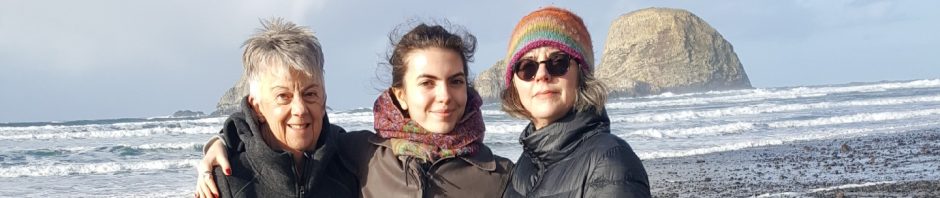
Welcome to the Gero-punk Project Blog! I am Jenny Sasser, a gero-punk (and a practitioner of Gerontological Anarchy).
What is a “gero-punk,” you ask? Well, far be it from me to claim to have a definitive answer, but I will say this: to be a true punk of any sort is to live experimentally, to live in love with emergence, with the unexpected, the chaotic, the improvisatory, to live with your arms wide open to complexity, guided by your own star, fuelled by a good measure of playfulness and well-intentioned rebellion.
Besides being a gero-punk (or in addition to being or by way of being) I am also an educational gerontologist with a commitment to contemplative practice, critical thinking, and collaborative and cross-generational modes of inquiry, learning, and praxis. I create formal and informal learning communities in which people engage questions about what it means to travel through the life-course together, about the minds we bring to exploring and understanding human aging, and about the implications for practice of the very ways we ask and attempt to answer questions that dwell at the heart of Gerontological teaching and learning. I offer learners various ways to explore such questions (and all of the other juicy questions which always emerge as we learn together!), through improvisation and play, reflection and rebellion, and unorthodox ways of writing and enacting our deepening and widening understanding.
Here are a few of the questions that preoccupy my work as a gero-punk educational gerontologist:
- What can we describe about aging phenomena, of traveling through the life course, from an experiential standpoint? How do we grow our capacity to be present to and communicate about our aging experiences, and to hear what others have to say about their aging experiences? And, when we reach the edge of our capacity to put experiences into words, what are other modes for expressing our experiences?
- How do we know we are aging? When we stop moving, stand still, and just breathe…where does age and aging reside? What is it, this thing we call age? What can we learn from engaging regularly in this contemplation? (Note: when we engage this practice in my Embodiment in Later Life course, one of the major insights students have is about the profound lack of solidity of the inter-related phenomena of age and aging and being old. These are concepts, they are experiences, they are social structures, and yet, and yet, in the stillness of breathing, eyes closed, they are without form and substance. How do we want to greet this paradox of the simultaneous experience of disembodied, timeless consciousness, on the one hand, and the embodied mind, the materiality of consciousness, on the other hand?)
- What happens when we take the theoretical principles we are learning in the context of our Gerontological education so seriously that we attempt to live our lives by them? What happens when we take our lived experiences so seriously that we attempt to live our lives as gerontologists by them? (What do we discover about the connections and disconnections between our life experiences and those of others, and what the Gerontological cannon — and the popular discourse(s) — has to say about the aging experience?)
- How do we experience our “outlaw emotions” –disillusionment and despair and disappointment and fear — that we may feel as part of traveling into the farthest reaches of the life course, as scholars and practitioners, and more profoundly as aging creatures, but feel silenced to express? Are we willing, as Elaine Brody and others have done, to tell what it is like to be an old gerontologist, and old person?
Well, I could think and talk about this stuff all day. But what do you think about this stuff?
P.S. For more on what it means to me to be a gero-punk, check out “A Gero-punk Manifesto.”
 Jenny Sasser, Ph.D.
 The Gero-Punk Project