A few weeks back, a venerable newspaper man asked me the question: Can a person be too old to be President? You might have seen his Washington Post editorial article in which I was quoted; I was glad to be included in the conversation but quite chagrined to see how much of what I’d had to say in response to what is a very complex question was left out of the article. But hey, it was his piece, not mine! (And their editor thought I was being too bossy.)
As of today, there are now 21 contenders for the Democratic primary election. When Joe Biden declared his intentions last week, and when Bernie Sanders declared his intentions in February, a query (and several memes and jokes) began circulating regarding their ages – Biden is 76 and Sanders is 77 — intimating that they are “too old” to be POTUS, and insinuating that this country doesn’t need – nor deserve? — another “old white guy” as its President.
I find this “too old” question fascinating and perplexing for several reasons. (I also find the “old white guy” question worth unpacking, but that’s for a future essay.) For starters, no one has yet to ask me whether I think Elizabeth Warren is “too female” or Corey Booker is “too black” or Pete Buttigieg is “too gay” (or Beto O’Rourke is “too punk rock.”). Now, it is quite possible that some Americans privately hold such views but it would be considered entirely unacceptable in public discourse to predicate questions about the fitness of these Presidential hopefuls on their gender, sexual identity, or race. And yet — seriously? — age is still fair game.
But as I’ve been pondering all of this, it occurs to me that it isn’t age per se that’s at issue, but aging (and growing old). Has anyone asked if Buttigieg, the candidate born most recently, is “too young”? Maybe someone has asked this, but what they mean when they ask this question is different than what it means to ask the question is Biden or whomever “too old.” When we ask if someone is “too young” to do something, what we are really wondering is if they have enough life experience and maturity. “Too young” is a proxy for “not enough experience.” In stark contrast, to ask if someone is “too old” to do something, what we are really wondering is if notwithstanding their vast life experience they might also experience aging-associated worst-case-scenario cognitive and physical decrements that would render them less “fit” for the demands of the role they are seeking.
(There are, not incidentally, three other characteristics considered to be a detriment for potential U.S. Presidents. Recently, a national poll was conducted regarding public attitudes toward the current candidates. The results are rather stunning: Respondents indicated that of various characteristics a candidate might have, the least popular characteristics are being Muslim, being over the age of 75, and being a socialist.)
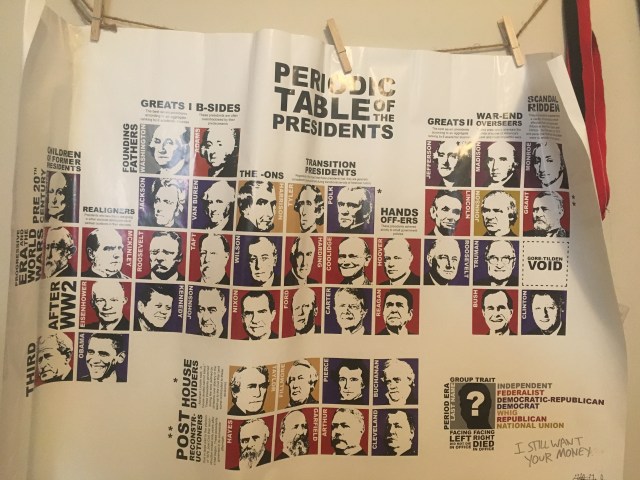
Another important dimension to surface here is the generational dimension, and the way in which “too old” serves as signifier for outmoded generational attitudes and beliefs. Speaking of generations, and this is somewhat to the side, do you realize that the 21 Democratic presidential primary candidates represent four different generations? Joe (born in 1942) and Bernie (born in 1941) are both members of the “Silent Generation”. On the other end of the generational spectrum is Pete Buttigieg (born in 1982), a member of “Gen Y”. In between, and this isn’t an exhaustive list, we have various “Boomers” – Elizabeth Warren (born in 1949) and Kamala Harris (born in 1964), though Kamala, who is on the “younger” end of the Boomer spectrum, might prefer to identify as a member of “Gen X”, like Beto O’Rourke (born in 1972).
I don’t know about you, but I think it is rather extraordinary that there are four distinct generations represented in this competitive and highly consequential field. It says something about the times we are living in. As well, generational placement can really mix things up and provide a rich source of diversity and difference (that’s oft overlooked). Why? Because when (not just where) you are born, when in history you find yourself emerging into existence has an influence on your experiences and opportunities as you travel through the life-course. All 21 candidates are alive at the same time, but their starting places span forty years! Grasp this: There’s a forty-year difference between the youngest candidate and the oldest candidates. What this means is that while they’ve had many social-historical experiences in common, these experiences are refracted through the particularities of each individual life, when they are from, not only where they are from; their gender, race, class, sexual identity, family of origin, belief system, access to social capital, but also the times in which they’ve lived and the ages they were when certain things happened (there’s a difference between being a kid and being an adult when something cataclysmic happens).
There are critical questions we might want to ask about the significance and influence of generational placement on the shape of an individual’s life. How influential are generational experiences? To what extent is there individual diversity within a generation (and from whence do these individual differences come?)? What do we think we can know about an individual — their attitudes, beliefs, and behaviors — by knowing their generational placement? When do we identify with our generation and when don’t we?
I have many more questions but that’s enough for now. This is a much longer conversation that I hope we will continue to have over time. What I most wish to convey is that I believe we would do well to think critically about the extent to which generational placement – not to mention chronological age — can serve as an explanation for individual attitudes, behaviors, and capacities. (Spoiler alert: they don’t serve very well.) I’d go even further and suggest that when we use chronological age or generational placement as shorthand for something that’s much more complex, we give into simplistic modes of thought and deny ourselves and others the opportunity to engage in more nuanced, albeit challenging, conversations about our hopes, fears, and needs for ourselves, our communities, and our nation(s), now and into the future.
+++
When my old socialist Muslim fairy god-person offers me the opportunity to make three wishes, my first wish will be that awareness and literacy about human aging will increase – soon and rapidly and across all generations. There’s still so much confusion about what constitutes normal human aging, not only because scientific knowledge is still and always emerging but because there’s still (and always?) a widespread repression of the realities of the human aging journey.
There are so many mixed messages about aging and later life and old age. And because of rampant ageism in U.S. society (and other societies), there seems to be a pervasive prohibition against truth-telling about old age. We avoid talking about the real changes and challenges that come as we grow older because we live in an ageist society and if we were to admit that in fact there are losses in capacity that come with aging, we might reinforce the ageism that already exists.
But even if we eventually vanquish ageism – Hooray for aging literacy! — and every other form of bias and discrimination and oppression, we human beings (and our other-than-human kin) will grow old and transform and one day return to the stars. We know how this story ends. But: Aging is not the same as dying. Aging is the mysterious, complex journey that all living creatures embark upon and one day complete.
Just so we don’t have any unnecessary misunderstandings, please know that I’m not making a case here for the idea that a person can be “too old” to be POTUS or anything else. Nor am I suggesting that old age is inevitably characterized only by decline and decrement. Our personal characteristics – include age and generation – should never be the criteria for determining our “fitness” for pursing an opportunity or serving in a role. But I am beseeching us to figure out ways to be honest about the fact that as we enter into the farthest reaches of the life-course we do experience significant changes, and we may want to take these changes into account as we decide how to devote our waning time and energy. And I am asserting that we do ourselves and each other a grave disservice by not being willing to talk about the complexity of aging and the multitude of ways in which humans experience old age and the fact that decline is part of this experience – we all know how this story ends! – and this decline is not a failure or a detriment but a part of our creaturely story.
My second wish has something to do with an emerging vision of legacy and inter-generational collaboration in the political sphere, and the role that people of great privilege, including the privilege of living a long and vibrant life, might play. But I’m still sussing so you’ll have to wait for a future essay to hear more. Stay tuned, will ya?
Oh, and my third wish is still TBD.

 Jenny Sasser, Ph.D.
 The Gero-Punk Project