Gero-Punk Ponderings: How long has it been that we’ve been loving each other?

One of the ways we track where we are in our own travels through the life course is by noting where our close ones are in their travels through the life course. The occasion of celebrating the birthday of a dear, close other — whatever species they happen to be a member of – offers one a moment of pause, an opportunity to reflect upon how it is that our precious lives are so tangled up together.

I just slid into the oven a sheet of coconut macaroons flecked with bittersweet chocolate. Macaroons – the down-to-earth flaked coconut haystack kind, not the fancy French bonbon kind (which are equally delicious!) – are my mother’s favorite cookie. I gave her a big mason jar full of them (a total of 12) as one of her Christmas presents. Purportedly, she allows herself to eat one a day, so by my calculations, if she began consuming them on December 25, 2015, she ran out of her macaroon supply around January 5, 2016 (give or take a day or two on either side of January 5th, in case she ate more than one macaroon on a particular day or, perhaps, skipped a day). So, time for me to replenish her supply!

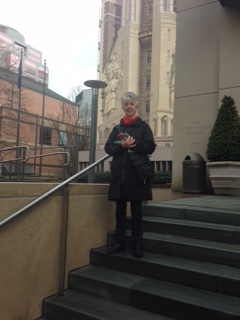
Today is my mother’s 70th birthday. The macaroons are one of the gifts I am giving her.

During our texting conversation this morning, when I wished her a happy birthday, she asked, “Am I really 70?!?! How did that happen?” My response: “Age is strange.”

Age (and aging) is strange.

Where does “70” reside?

Certainly after having lived on this planet, with its gravity and other peculiar forces, for several decades, one’s body shows and feels the impact. But what does “70” look like? My mom is “70,” my mentor and comrade Rick Moody is “70”…they look like themselves, they look to me as they’ve always looked, though I will admit that they look like themselves in a more…how shall I say it…definite, singular and true way.

Where does “70” reside?

The accumulation of birthdays is probably the least interesting definition of one’s “age.” What would happen if we defined aging as the process of becoming more complex through a life deeply lived? Where would our age reside within such a definition? Rather than our age, perhaps we’d talk about our lived experiences (especially the messy ones), and what we’ve learned about ourselves and others through ongoing thinking and reflecting (alone and together), and by being willing over and over to try to have delicate, brave conversations.

What if, in addition to noting our own and others’ chronological ages, we marked our travels through the life course by celebrating how long it is that we’ve been riding together on a bright red arrow that’s flying though space and time?

What if we toasted to the shared mystery of embodying a particular age, all ages and no age, all at once?

Perhaps the best question we could ask, on the occasion of a birthday, would be: How long has it been that we’ve been loving each other?

Mommy, Susan Hotz, how long has it been that we’ve been loving each other?

Happiest of birthdays (enjoy the macaroons)!

mom

Posted in Uncategorized | Leave a comment

Gero-Punk Book Review: Gratitude

books

Who was it who told me — decades ago, now — that to become a better writer, one should read widely and well? I wish I remembered who it was because if I remembered, I would thank them for their advice, advice I have passed down to many generations of my own students over the years, especially when I’d hear them say that they didn’t have time for “pleasure reading” because they had to focus on their school-work.

One must always take time for pleasure, in books and otherwise, I would tell them.

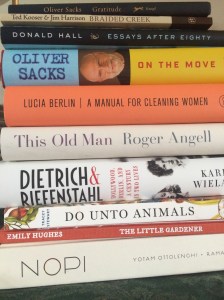
Speaking of pleasure, I received quite a varied collection of books as gifts during the winter holidays. I’m grateful to have thoughtful people in my life who not only know I’m a serious and wide-ranging reader, but who know me well enough to know the kinds of books that will capture my attention. But of all the times for me to pull in such a delicious haul of books, this ain’t it, because there’s this book that I’m in the process of writing (co-authored with Harry Rick Moody), and the last thing on earth I need right now is the distraction of reading anything but what is absolutely necessary as fodder for my own writing.

But far be it for me to be a person who just says a bunch of stuff she doesn’t actually practice!

I will confess to having read through Ottolenghi’s latest cookbook, Nopi, a gift from my daughter Isobel, at least twice, because it focuses on beautiful food and, hey, a girl’s gotta eat, right? Not that I’ve actually made any of the recipes yet—I’m still in the fantasy stage with Ottolenghi, imagining what it will be like the first time. If you aren’t familiar with the Israeli chef Yotam Ottolenghi, I would urge you to check him out – start with his first book Plenty.

I also read – in one sitting, on January 2nd when I was still technically on winter break – a short book of poetry, Braided creek. My friend David sent it to me for my birthday. Actually, it would be more precise to call it a poetic dialogue between two poets, Ted Kooser and Jim Harrison, who are also dear longtime friends. Here’s one of their little bits I quite like:

“Do you feel your age?” she asked,

so I squeezed my age till it hurt,

then set it free.

Braided creek would be great to read alongside Essays after eighty, by Donald Hall (though I’m cheating because I received that from Simeon the birthday before last). In the first essay in the collection, “Out the window,” Hall writes,

After a life of loving the old, by natural law I turned old myself. Decades followed each other – thirty was terrifying, forty I never noticed because I was drunk, fifty was best with a total change of life, sixty began to extend the bliss of fifty – and then came my cancers, Jane’s death, and over the years I traveled to another universe. However alert we are, however much we think we know what will happen, antiquity remains an unknown, unanticipated galaxy. (p. 7)

Hall goes on to share with the reader the ways in which others remind the old, lest they forget, that they are “extraterrestrial,” that is, alien and “a separate form of life.” This is hard news for me to hear, I don’t want it to be true. But Hall speaks with the authority of his own lived experience. And so.

Speaking of the incontrovertible authority of lived experience, I’d invite you to explore the final essays by Oliver Sacks, Gratitude. Erica gave me this little book (and I gave a copy to my mother), along with Sacks’s memoir, On the move, which I just started reading this week; so far, so good!

Collected in Gratitude are four essays, written between 2013 and 2015. The first essay, “Mercury, Sacks wrote on the occasion of his 80th birthday. The other three essays were written after Sacks discovered that his cancer, which had been in remission for a decade, had returned and was killing him. I had read three of the four essays in The New York Times, where they were originally published in close proximity to when Sacks wrote them. Reading them as standalone essays in the Sunday NYT was a blessed, revelatory experience. Sacks writes about the past, the passions and preoccupations of his youth that have shaped him and stayed with him. But these essays serve not only as bits of memoir, but as a testament to what one might discover by bravely being present to one’s own demise. Sacks’s words directly transmit a kind of embodied, worldly wisdom, they portray a way of living a life that is noble and fresh in all of its complexity, especially at its inevitable end.

Sacks’s final few months on earth coincided with the months this past fall when I was facilitating statewide conversations for the Oregon Humanities Talking About Dying program. The generosity with which Sacks shared with his many readers his lived experience of dying, the grace and gratitude with which he greeted his own end, emboldened me as I tried to foster conversations with strangers about their own ends.

Returning to these essays after having had the experience of facilitating Talking About Dying, and in such close proximity to Sacks’s death, and reading them all together, one after another, was a strange and staggering experience. The essays were familiar to me because I already knew them in their singular forms; but side-by-side, their impact was to leave me dizzy and warm and teary. When I finished, I put my hands on my face, covering my eyes, and I shook my head and said, “Oh! He was just such a generous, brilliant human!” Only later did I suggest to Simeon that he read them (he did). And I texted my new friend Annie to ask her if she had the collection, as we’d talked about a couple of the essays when they were first published in the NYT. I wonder if my mom has read them yet? I’ll be sure to ask her.

I’ll end this tribute to the pleasures (and sorrows) of reading (and writing) writing in all its many forms with a quote from the third (and my favorite) essay in the collection, “My periodic table”:

A few weeks ago, in the country, far from the lights of the city, I saw the entire sky “powdered with stars” (in Milton’s words): such a sky, I imagined, could be seen only on high, dry plateaus…. It was this celestial splendor that suddenly made me realize how little time, how little life, I had left. My sense of the heavens’ beauty, of eternity, was inseparably mixed for me with a sense of transience—and death.

I told my friends Kate and Allen, “I would like to see such a sky again when I am dying.”

“We’ll wheel you outside,” they said. (p. 25)

Dr. Oliver Sacks was a citizen of the entire world. No! A citizen of the entire universe! He was at once a curious boy and an explorer and a brilliant scientist and a compassionate doctor and a compelling writer and a lover of all creatures.

He died as he lived.

So shall we all.

 +++

Hall, D. (2014). Essays after eighty. New York: Houghton Mifflin Harcourt.

Kooser, T., & Harrison, J. (2003). Braided creek: A conversation in poetry. Port Townsend, WA.: Copper Canyon Press.

Ottolenghi, Y., & Scully, R. (2015). Nopi. Berkley, CA.: Ten Speed Press.

Sacks, O. (2015). Gratitude. New York: Alfred A. Knopf.
Posted in Uncategorized | Leave a comment

Gero-Punk Practice: A Happy Story

happy stay happy

A bright red envelope arrived in yesterday’s mail. While the envelope was hand-addressed to me, the contents of the envelope weren’t intended for me. Inside the envelope was a get-well-soon card for Happy-the-dog. The card was handmade by Julia, my best friend’s daughter. Julia is 10 years-of-age and we are friends, too. On the outside of the card, Julia wrote: “Happy Stay Happy!” (I wonder if the double play on words was intentional? Knowing Julia – she’s such a smarty! — it likely was.) As for what she wrote inside the card, that is private – from Julia, to Happy. But given that I was the one to read the card to Happy, I can assure you the sentiments inscribed inside were thoughtful and cheery.

Happy had major surgery last Thursday, thus the card from Julia entreating him to get well soon.

Happy is almost 12 years-of-age. He’s considered an “older dog,” a dog with some special aging-related needs, though he still gets mistaken for a puppy almost on a daily basis because of the style with which he moves through the world. I, of course, do not believe that curiosity and vim are the exclusive purview of the young, but Happy’s energy seems almost universally read as youthful, even now.

According to a special mathematical formula which takes into account the size and weight as well as chronological age of a dog, Happy is approximately 69 in human years. My mom is 69 (for a few more days). This past December, Simeon turned 59 and I turned 49. Isobel is 19 (until February 14th). I don’t know why, but I think it is so totally cool that each of us at the same time has a “9” as the second digit of our chronological age! This is particularly cool given that Happy, being that he is a dog and not a human, is traveling at a different rate of speed than we are. When Happy and I first met, he was younger than I was; he and Isobel were actually around the same age. Then for a chunk of time, Happy and I were experiencing the same life-course stage as full-on adults. And then – it felt sudden – Happy picked up speed and passed me on the imaginary number line, leaving me in mid-life as he entered into his later years.

I imagine that despite the fact that we are moving at different speeds, for now we are all riding together on a bright red arrow that’s flying through space and time.

Happy’s surgery was to remove a kind of tumor that older dogs of certain breeds tend to get. The tumor showed up some time ago and his doctor had advised us to just keep an eye on it since the results of all of Happy’s lab tests and physical exams had consistently demonstrated that he is a remarkably healthy mister dog. But a couple of months ago, the tumor starting growing more rapidly and changing in shape, signs that it was time for us to intervene.

I’ve been mostly housebound since Thursday taking care of Happy as he recuperates (with a lot of help from Simeon, from whom Happy willingly, almost cheerfully, takes his medications, and for whom Happy actually sits without being asked when it is time for his treat!). My shoulders and arms have been sore the past couple of days and it occurs to me only now as I write this that perhaps it is in part because until yesterday I had been picking up Happy to carry him down the back stoop steps so he could go potty in the yard. I’d put my right arm under his belly and my left arm under his chest, so as to avoid his very large and deep incision, which is on the upper part of his right back leg. It isn’t that he’s a terribly big dog – I think the most he has ever weighed it 46 pounds – but he is a four-legged, sovereign creature who isn’t accustomed to being picked up and moved around, nor am I accustomed to doing so. I think my shoulders may hurt also because even though Happy is doing remarkably well post-operation, I’m holding some concern, some mild anxiety, in my body. And I don’t sleep well unless he sleeps well.

I am Happy’s human and Happy is my dog. We are kin. When Happy is puny, I can’t help but feel a bit puny myself. And it happens the other way, too – Happy grows quite concerned when he detects any turbulence in me. We are strangely connected. We really love each other, and this is how it is with true love.


Posted in Uncategorized | Leave a comment