Gero-Punk Tribute: Fred’s Figs, Part Two

The family from down the street is almost completely moved in to the new huge house erected across the street from my house, right on top of where Fred’s garden used to be.  It took them every minute of yesterday and they were still working late into the evening. Around eleven o’clock last night I went out into my front yard to look across the street at their house ablazing with lights and I noticed the silhouette of one of the twin boys in the third floor dormer window.  I gazed at him for a bit and then waved.  He jumped and skittered away! Perhaps he thought he had the perfect spot from which to survey me and my home and I blew his cover! Or perhaps he was getting himself oriented in time/place/space and was feeling a bit jumpy being that last night was his first night sleeping in his new bedroom (and without his twin, who has his own bedroom in the new huge house.)?

Any way, I am pleased to report that my new across the street neighbors are happy and excited (despite being very tired) about being in their new huge house on this hot summer day, the day before Independence Day 2013. 

In previous summers around this time in July the bean vines would be just beginning their climb up the trellises, the raspberries would be rallying themselves for another round of fruiting, the figs would still be hard and small. I’d be watering the garden daily and cutting roses from the old bushes and wondering if we’d have a good tomato output this year.

Every day of every year is auspicious in its own way. Today is auspicious because the family from down the street is settling into the house of their dreams. Today is auspicious because the two tomato plants happily living in my raised beds and coaxed from seeds Fred’s son saved from previous summers’ plants are setting blossoms and seem to have survived a recent assault from little bugs that ate holes in their leaves.

In honor of this auspicious day please accept Part Two of “Fred’s Figs: A Legacy Tale”, written in August 2010, the summer after Fred died. (You might want to read Part One, if you’ve not done so previously.)
ImageFred’s Figs: A Legacy Tale (Part Two)

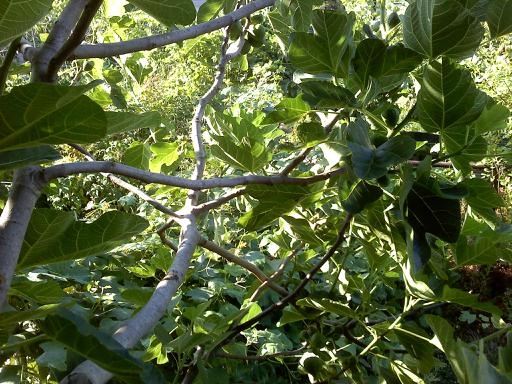
I had intended to offer Fred’s figs as dessert at a picnic my friend Erica, her children, Isobel, and I planned. So yesterday afternoon I headed into the garden, wandering past the zucchini, corn, and tomatoes, pausing periodically to check on the ripeness of various fruits and veggies, acknowledging the spent raspberries and close-to-finished potatoes to my left, anticipating the sweet perfection of Fred’s Figs. The figs looked sound as I approached the tree, but I discovered upon gently grasping a fig that while I had been away from the garden for a few days Fred’s fig tree had been taken over by starlings and yellow jackets and a couple of hummingbirds. All of the enormous, sexy, ripe figs had been poked with little holes (hummingbirds), eaten from the inside-out (yellow jackets) or almost completely consumed and left like deflated balloons dangling from their stems (starlings).  Fig pulp dripped onto my head and blouse, yellow-jackets buzzed in my ears, and I realized that there would be no figs for dessert. I was already running late for the picnic, so I didn’t even have time to change out of my stained blouse, nor fix my bangs, which were stiff and sticky from the pulp.

The only consolation for my disappointment was the knowledge that the last basketful of glorious ripe figs was quite appropriately consumed by a group of World War Two veterans. As Izzy and I were leaving town the weekend right before the fig incident I just reported, we offered to a friend the figs that I’d just picked (ripe figs don’t travel well) thinking he could share them with his colleagues at the Portland Veterans Affairs Medical Center. Turns out his colleagues loved Fred’s figs and so did his wizened old vets. I love remembering Fred’s stories about serving in World War Two – Perhaps he even served with some of the V.A. clients who recently enjoyed eating his figs! Maybe they were in the unit with Fred that liberated one of the concentration camps? What if all of these years later, Fred’s figs were being gobbled by his contemporaries.

Today, the day I write part two of “Fred’s Figs,” was the very day of the month when I offer a collaborative inquiry session at Mary’s Woods, a continuing care retirement center next door to the university where I teach.  I’ve been offering a monthly session since this past January, and will do so for the rest of this year and as long as they’ll have me.  The custom is for me to read a short piece of writing, usually something I’ve written or am in the process of writing, and then we spend the remainder of our time surfacing themes, making connections between what was read and our own experiences, reminiscing about the past, and talking about our present lives, too.  So, today I read “Fred’s Figs: A Legacy Tale, part one.”

After a short span of silence after I read the little essay, the group participants offered many thoughtful, even surprising insights and stories from their own lives.  One gentleman, P., sighed, paused, and then said, “I think you vividly illustrate the web of life, and how it crosses generations.  I like the feel of your essay.”  His wife, D., remarked: “When people have died, they live on in us – in our memories and the stories we tell. You and your daughter are so lucky that you had Fred in your lives.” Another woman, H., remembered how as a young girl she met her lifelong best friend because of a cherry tree, the kind that grows the bright red little sour cherries best for pies. The cherry tree grew in the yard of her friend’s family’s home, and H. and her best friend started out as enemies – the future friend had caught H. stealing cherries from the tree! Then P. shared another story having to do with a dilapidated row-house in 1960s inner-city Philadelphia.  He reminisced about renovating the row-house and living happily with his family for many years in the middle of an ethnically and economically diverse neighborhood. The highlight of the story was his mention of the plate of ripe figs offered to him supposedly as a housewarming gift by a local progressive politician who showed up on his front stoop; from there after, and with a bit of rueful suspicion, P. and his wife referred to figs as “political figs.”

The Mary’s Woods group and I went on to talk about gardening, of the gardens we’ve known, the gardens we tend now, as well as the merits of letting plants do what they want, letting the garden exist in some indeterminate zone between absolutely wild and overly designed.  And we connected this strong, shared sensibility about our role as human stewards of micro-agriculture to a more expansive, aspirational commitment to letting other creatures become and be who they want to be, acknowledging the delicate balance to be sussed and cultivated between providing structure on the one hand, and freedom on the other, for those who are under our care, whether children, frail elders, partners, companion animals, neighbors, colleagues, or vulnerable members of the community. 

After I returned home from Mary’s Woods, Fred’s son Peter stopped by to say hello, check in, and offer me some green beans from Fred’s garden. He also brought some figs—smaller, harder, and less sexy than the figs from last week that the WW2 vets gobbled. He has it in mind that we must fight a battle to save the rest of the figs from the humming birds, yellow jackets, and starlings. As well, he says he’s going to make some fig jam this weekend.  I told him about my harrowing experience in the fig tree yesterday, in vivid detail, of course, and then we reminisced about our past experiences with yellow jackets – he shared a story from his boyhood about how he and his friend were pursued through our neighborhood by a swarm of hornets; I shared about being stung multiple times on my head while riding a horse in the Oregon backcountry and how I had to dunk my head in a snow-melt mountain river and sleep off the venom-hangover in a bivouac. We laughed and commiserated, and then turned our conversation back to Fred’s figs. We wondered if there was still a chance for the unripe, hard little figs to ripen, and we acknowledged that had we remembered to put foil strips on the tree branches and enlist the scarecrow in security detail, we’d probably still be enjoying the best of Fred’s figs. We made some provisional plans for next year’s growing season and turned our attention to re-sowing the lettuce.

We could probably get another two months of lettuce from the garden, especially if we have an Indian summer.


Posted in Uncategorized | Leave a comment

Gero-Punk Tribute: Fred’s Figs

Some of you know of my dear friend Fred Rigutto, my former across-the-street neighbor and gardening partner.  You’ve probably heard me speak of him and his wonderful garden many times over the past several years. Some of you have read the three part essay, “Fred’s Figs: A Legacy Tale,” that I wrote in his honor after his death in 2010 – perhaps you even saw the little digital story I cobbled together based on the first part of the essay. Though many of you newer readers of this blog have neither seen nor read “Fred’s Figs,” you’ve never heard me talk about my dear friend Fred, you’ve never had the pleasure of catching a little glimpse of him through me. You have little or no context for my periodic mentions of Fred in my Gero-Punk Project essays, such as in the recent piece “Raspberry Legacy.”

So maybe it would be a keen idea if I let you in on what’s what as far as my friend Fred is concerned.

This will be my fourth summer without my friend Fred by my side. I’ve been trying for what feels like forever to write part four or five to follow the first three  parts of “Fred’s Figs: A Legacy Tale” but I haven’t been able to. Writing usually works when I’m trying to process something. Yet all I have been able to manage for the past year or so insofar as my relationship with Fred is concerned are fragmentary utterances, sometimes written down in my journal, most often not. But I have done a hell of a lot of purposeful contemplation on Fred and his legacy. I have forced myself to do so because I needed an escape route out of my enormous anger about the destruction of Fred’s garden, about his adult children’s abdication of carrying forward his legacy, about the rapidity with which they turned on each other after his death.  And I needed a way to manage my grief at the loss of such a true and precious friend. So I turned all of it – the whole heaping pile of  intense emotions – into compost to grown my gero-punk practice.

And in so doing I discovered that there are many ways to leave a legacy.

Tomorrow is an important day in the ongoing story of Fred’s legacy, which is why I’m telling you all of this. Tomorrow a young family from down the street will be moving into the enormous new house that has been constructed on top of what was once Fred’s garden (the enormous new house that blocks my view of the southern sky and sits upon what used to be an entire city lot’s worth of garden).  I’ve been watching the construction of the house since this past January. On the day in February of the Presidential inauguration I watched simultaneously as President Barack Obama was sworn in for a second term as President of the United States and as Fred’s fig tree was ripped out of the ground and torn limb-by-limb by a machine.  I sobbed at the destruction of what was left of Fred’s tender care and hard work; god, he loved that garden! I thought I’d never recover, never adapt, never accept the inevitability of the enormous new house that would soon be erected on top of Fred’s beloved garden.

And truth be told, I was still being a brat about all of this until a few weeks ago when I found out who had bought the new enormous house – sweet folks with three little kids from the neighborhood, neighbors who knew Fred and ate raspberries from his garden. Upon hearing the news I immediately felt a happiness that was genuine, unforced in any way.  Upon hearing the news I decided that if there was going to be a new enormous house across the street from my house, what better outcome could there be than for a wonderful family to dwell in the house that grew in Fred’s garden.

In honor of this auspicious occasion and to mark this new phase of Fred’s legacy, please accept part one of “Fred’s Figs: A Legacy Tale.”


ImageFred’s Figs: A Legacy Tale (in three parts)

-Part One-

I prepared myself to scramble up the tall, rickety wooden ladder. It’s been leaning against the fig tree since last summer. Fred left it there at the ready in order to gather the figs before the birds could steal them and the bugs could eat them from the inside-out. Fred, my old friend, the angel of our neighborhood, died on January 28th, 2010, after 85 trips around the sun. Now, he’s back in the stars, but this is still his fig tree, still his garden – almost a mini urban farm – and Fred will always dwell here. For the past six summers, Fred has offered me figs from his tree; this summer, the growing season of 2010, I will carry on his sweet fig-giving custom. And I will serve as caretaker of Fred’s garden.

I discovered the first ripe fig of this summer last night because I bopped into it as I was heading into the garden to water. The fig was dangling, bulbous and green, a lovely ornament.  I was caught very much surprised by the ripe fig, as last I’d checked, on the previous Sunday, the figs were seemingly days away – weeks, even – from ripening; the tree was covered with many small, rock-hard dark green tear-shaped drops.

So, last night when I discovered the ripe fig, or, maybe the ripe fig discovered me, I wondered if perhaps there were more – how could there be only one ripe fig?  I decided to ascend Fred’s ladder high into the lush uppermost branches so as to look down upon and from within the tree and survey it for potentially ripe fruits. Lucky me! I found two more!

I also acquired a wholly new view of Fred’s garden: To the lower left, through the layers of lush leaves and branches, the rows and rows of heirloom tomatoes (after Fred died and we were making early preparations for this year’s garden, Joanne, Fred’s daughter, and I found plant tags in the greenhouse. On the tags Fred had written in black marker “a-i-r l-o-o-m” for use in indicating which seedlings were collected from last season’s crop of round, gorgeously purple Russian heirloom tomatoes.).  Glancing diagonally toward the middle of the garden, being careful not to fall off the ladder, I saw the island of raspberry bushes, now finished fruiting; the patch of new potatoes, ready to be excavated with a pitchfork; the ancient apple trees who no longer offer fruit.  Rising up on the near horizon at the garden’s edge, the pole beans, and vines stretching in all directions— small purple buds – future beans! To the right – opportunistic weeds, asparagus stalks gone-amok, misbehaving roses, and colonizing grape vines.

As I perched in the fig tree, so far above the ground below (where there was garlic planted until we pulled it up for curing last week), I had many memories visiting from near and far flash through my mind. I was a major tree climber as a girl, and I closed my eyes momentarily and asked myself this question: What age do I feel right now, tangled in the arms of Fred’s fig tree?

I also had a strong, visceral remembrance of visiting my dear friends Sara and Herb the year before Sara died of quickly-spreading cancer, at the house on the west bank of the Willamette River, just north of the Sellwood Bridge. They’d invited my daughter Isobel and me over to help pick ripe figs. Herb, my elder brilliant colleague, and his wife Sara, a precious comrade, enjoyed only a couple of years at most in that house on the river – they’d just gotten the interior walls tinted the dessert colors Sara saw in her imagination, planted some new plants in the well-established garden, hosted a fantastic Passover Seder for which Isobel and I made homemade kosher chicken soup with two kinds of matzoth balls: the small dense kind that sink, and the large fluffy kind that float! 

I’ll never forget that charming, hilarious experience helping them pick figs on a late summer afternoon at their final home as a couple.  Herb on an almost too-short ladder propped against the old, lush fig tree; Sara watching from an upstairs window (we broke the screen as we tried to pry it widely enough for her to lean out and see Herb straining as he reached up to pluck figs), alternating between begging him to be careful and bossing him about where the best figs were and the proper technique for picking them (in response to which Herb sweetly sang songs to Sara promising to be careful, reminding her that he was an old man with many years of ladder-climbing experiences to call upon.).  Izzy and I stood on the deck below the tree with bushel baskets – I attempted to catch the figs as Herb tossed them down to me, and then I handed the figs to Izzy, who placed them in the baskets for safe-keeping, occasionally eating a fig that was too ripe to carry back to our house on our bicycles.

Now as I eat figs too ripe to carry across the street from Fred’s garden to my house, I think about the legacy Fred continues to give me, though our relationship exists in a different dimension now that he’s no longer living. To be trusted with the caring for Fred’s garden, a garden that has grown perpetually for 85 years, tending the plants, cultivating the land, allows me to continue my relationship with him. To spend Sunday afternoons with his adult children pulling weeds and gathering the harvest allows me to expand my relationship with Fred, to learn new things about him, about his people.

I’ve even adopted some of his habits-of-speech. I hear myself asking a friend, “Could you use some figs?”  I take delight in watching my friend break open the green flesh to discover the sweet purple insides of one of Fred’s figs.


Posted in Uncategorized | 7 Comments

Gero-Punk Contemplation: Raspberry Legacy

Feeling warm nectarine juice dripping down my chin; watching chickadees snatching seeds before the jays can monopolize the bird feeder; getting caught in the mingling sexy scents of the trio of tomato plants, I remember the bit of text from Annie Dillard’s Pilgrim at Tinker Creek that Isobel’s father and I borrowed to use on her birth announcement:  “…A single cell quivers at a windy embrace; it swells and splits, it bubbles into a raspberry…Soon something perfect is born. Something wholly new rides the wind.” 

I can’t help but think about the raspberry shoots dug up from Fred’s overgrown garden last summer (the garden’s last summer) and then transferred into a newly prepared plot in my side yard. Fred’s gone, and now his garden is gone, too, but this summer we’re enjoying a new generation of Fred’s raspberries—three handfuls, so far.

 Image

(There’s a soon-to-be-occupied huge new house sitting on top of Fred’s garden, covering the ground where the raspberry canes, artichokes, asparagus, irises, and ancient fig tree used to dwell. But that’s a story for another time.)

Before I ate the nectarine, I had been intentionally contemplating my ancestors. I was reminding myself of — or, rather, I was trying to remember – the creatures from whom I’ve come, the creatures whose miraculous existences millennia ago preceded my existence and my daughter’s existence. I was day-dreaming about the spiral of development and transformation across time of which we are all a part. 

I was imagining how if were I to draw my creaturely family tree it would begin with multiple species of microbes, followed by worms and snails, then fishes, amphibians, dinosaurs, reptiles and (my favorite ancient family members) birds. Long before my Gramma Jewell shows up on the family tree, and long before her grammas and all the generations of grammas (and grandpas, and mammas and papas and all the other human kin) who came before her, there was Gramma dinosaur, Gramma sturgeon, Gramma tree frog, and Gramma goose.

And don’t forget the plants! There are also a ton of plants in my family tree, because on this planet creatures and plants can’t do anything without each other.

I realize again that the strong concepts I’ve been circling around in so much of my recent thinking, writing and praxis – legacy, kinship, and elderhood, to name three – have transpersonal, cross-creaturely, and metaphysical resonances. When we think about the human journey – being alive at/in this time/place/space – let’s not forget the other creatures with whom, because of whom, we travel. When we think about our kin, our elders, our ancestors, and our descendents, let’s remember the resplendent living world of creatures – not just human beings — with whom we are inexorably interconnected.  When we think about answering the call to become an elder – now or in the future – let’s expand our conceptualization of this sacred vocation to include a commitment to doing our part to heal the world and all its creatures, not just in the present or on behalf of near-future generations, but on behalf of far-future generations of creatures of all sorts (even sorts which don’t yet exist!) whom may never know we even existed.

Maybe our far-future kin will contemplate our existence so long ago in the very distant past (which is our present, now!), perhaps they will imagine our special place in their family tree, and they will be grateful that we not only existed but developed and transformed in such a particularly perfect way that something wholly new could one day ride the wind.


Posted in Uncategorized | 2 Comments